
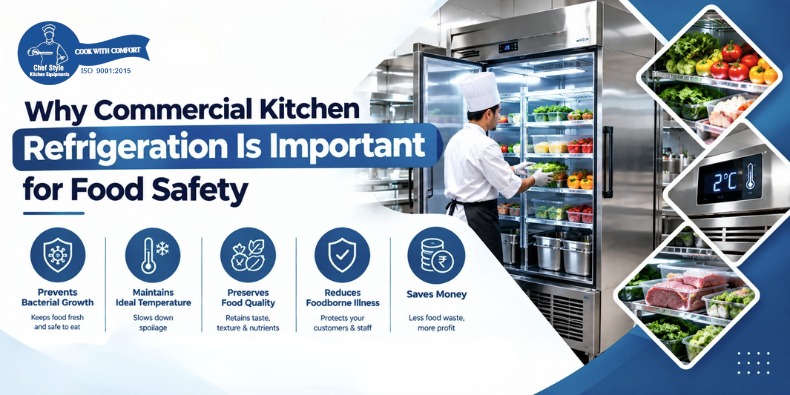
Food safety is one of the most important responsibilities of every restaurant, hotel, café, bakery, cloud kitchen, and catering business. While proper cooking and hygiene are essential, safe food storage is equally important. This is where commercial kitchen refrigeration plays a major role.
Fresh vegetables, dairy products, meat, seafood, prepared ingredients, and other perishable foods need suitable temperature-controlled storage to maintain their quality and reduce the risk of food spoilage. Choosing the right commercial refrigeration equipment and maintaining it properly can support safer and more organised kitchen operations.
Why Refrigeration Matters in a Commercial Kitchen
Restaurants handle large quantities of perishable ingredients every day. Unlike a home kitchen, a commercial kitchen may open and close refrigerator doors frequently and store ingredients for extended periods.
A reliable commercial refrigerator helps maintain stable storage conditions and protects ingredients from excessive temperature changes. Proper refrigeration can also help restaurants maintain the quality, freshness, and usability of ingredients until they are ready for preparation.
Helps Reduce Food Spoilage
Temperature control is essential for protecting perishable foods. If ingredients are stored under unsuitable conditions, their quality can deteriorate more quickly, leading to spoilage and unnecessary food waste.
A properly selected commercial refrigerator or freezer provides suitable cold-storage capacity for the restaurant’s daily requirements. Maintaining consistent operating temperatures and avoiding excessive overloading can help refrigeration equipment perform more effectively.
Supports Safe Storage of Different Ingredients
Different ingredients may have different storage requirements. Meat, seafood, dairy products, vegetables, sauces, and prepared foods should be organised properly inside commercial refrigeration units.
Separating ingredients and maintaining an organised storage system can help reduce cross-contamination risks and make it easier for kitchen staff to monitor stored products.
Using separate sections or suitable storage containers can also help maintain a cleaner and more organised refrigeration system.
Choosing the Right Commercial Refrigeration Equipment
The refrigeration equipment required depends on the restaurant’s menu, kitchen size, storage capacity, and daily ingredient usage.
Depending on their requirements, businesses may consider upright refrigerators, under-counter refrigerators, commercial freezers, display refrigerators, or larger cold-storage solutions.
Selecting the right capacity is important. A refrigerator that is too small may become overcrowded, while an unnecessarily large unit can increase energy consumption and occupy valuable kitchen space.
Temperature Monitoring Is Important
Simply owning a commercial refrigerator does not guarantee safe food storage. Restaurant staff should regularly monitor refrigeration temperatures and ensure that equipment is operating correctly.
Temperature monitoring can help identify problems such as unexpected temperature increases, poor cooling performance, or equipment failure before they result in significant food loss.
For food safety, businesses should follow applicable food-safety requirements and manufacturer recommendations for the specific refrigeration equipment they use.
Avoid Overloading Refrigeration Units
Overloading a commercial refrigerator can restrict the circulation of cold air and affect cooling performance. When ingredients are packed too tightly, some areas may not receive adequate airflow.
Restaurant staff should organise ingredients properly and leave sufficient space for air circulation. This can help the refrigerator maintain more consistent cooling conditions.
Regular Cleaning and Maintenance
Commercial refrigeration equipment requires regular cleaning and maintenance to perform effectively. Dirt, food spills, ice accumulation, and blocked ventilation areas can affect equipment performance.
Door seals should also be inspected regularly. Damaged or loose seals can allow cold air to escape, making the refrigerator work harder and potentially increasing energy consumption.
Scheduled professional servicing can help identify mechanical problems early and reduce unexpected breakdowns.
Refrigeration and Food Hygiene
Good refrigeration practices should be part of the restaurant’s overall food-safety system. Clean storage areas, proper ingredient organisation, temperature monitoring, and regular equipment maintenance all contribute to better food-handling practices.
Refrigeration should work together with other kitchen practices such as proper cooking, cleaning, hand hygiene, ingredient handling, and stock rotation.
Choose Reliable Commercial Kitchen Equipment
Since refrigeration equipment operates for long periods, reliability is an important consideration when selecting a commercial kitchen system.
Restaurant owners should consider equipment capacity, construction quality, energy efficiency, warranty, maintenance requirements, and after-sales support before purchasing.
Working with an experienced commercial kitchen equipment supplier in India can help businesses select refrigeration solutions according to their kitchen size, menu, storage requirements, and expected workload.
Final Thoughts
Commercial kitchen refrigeration is an essential part of food safety and restaurant operations. Proper refrigeration helps protect perishable ingredients, reduce food spoilage, maintain food quality, and support organised food storage.
However, choosing the right equipment is only one part of the process. Regular temperature monitoring, correct storage practices, cleaning, preventive maintenance, and proper staff training are equally important.
For restaurants, hotels, cafés, bakeries, cloud kitchens, and catering businesses, investing in reliable commercial refrigeration equipment can support a safer, more efficient, and better-organised kitchen.
Chefstyle Kitchen Equipment provides commercial kitchen solutions designed around the practical requirements of professional food businesses. From refrigeration and cooking equipment to food preparation and stainless steel kitchen solutions, the right equipment can help create a more efficient commercial kitchen environment.