
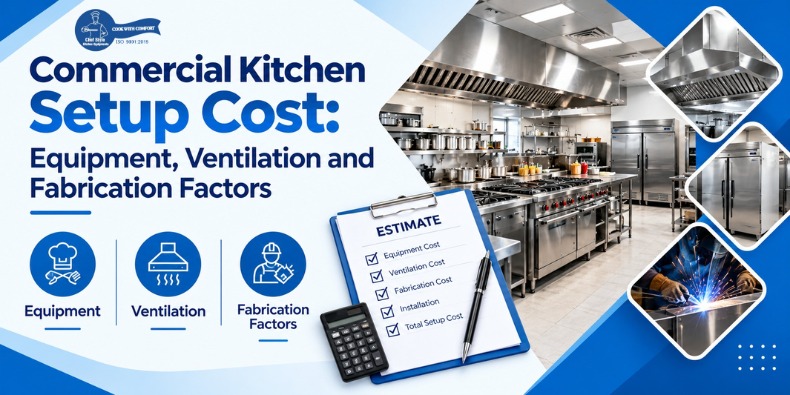
Setting up a commercial kitchen requires careful budgeting, equipment selection, and space planning. Whether you are opening a restaurant, hotel, cloud kitchen, bakery, or industrial canteen, understanding the factors that influence commercial kitchen setup cost can help you plan your investment more effectively.
The total cost of a commercial kitchen depends on several elements, including the size of the kitchen, cooking equipment, stainless steel fabrication, refrigeration, ventilation systems, installation requirements, and expected food production capacity. Instead of focusing only on equipment prices, businesses should consider how each component contributes to efficient and reliable kitchen operations.
In this guide, we explain the major factors that affect commercial kitchen setup cost and how to plan a kitchen that meets your business requirements.
What Is the Cost of Setting Up a Commercial Kitchen?
The cost of setting up a commercial kitchen varies according to the type of business, available space, equipment specifications, and level of customization required. A small café, a full-service restaurant, and a large hotel kitchen will have different equipment and installation requirements.
For example, a compact food-service business may need basic cooking equipment, preparation tables, refrigeration, and washing facilities. A high-volume restaurant or institutional kitchen may require multiple cooking stations, bulk cooking equipment, larger storage facilities, dedicated exhaust systems, and customized stainless steel workstations.
The most effective way to estimate commercial kitchen setup cost is to prepare an itemized budget based on your menu, expected production volume, kitchen layout, and operational requirements.
- Commercial Kitchen Equipment Selection
Commercial kitchen equipment is one of the major components of the overall setup budget. The equipment required depends on the type of food being prepared, the number of customers served, and the expected volume of daily operations.
Common equipment includes commercial cooking ranges, ovens, steam cooking equipment, preparation tables, food display counters, refrigeration units, deep freezers, and dishwashing systems.
When preparing your equipment budget, consider the following factors:
- Equipment size and production capacity.
- Material quality and construction.
- Energy source and utility requirements.
- Cleaning and maintenance requirements.
- Warranty and after-sales support.
- Installation and commissioning costs.
Choosing equipment based only on the lowest purchase price may not provide the best long-term value. Businesses should compare specifications and select products that match their daily workload.
A well-planned equipment list also helps prevent unnecessary purchases and makes it easier to allocate the budget across essential kitchen operations.
- Commercial Kitchen Ventilation and Exhaust Systems
Ventilation is an essential part of commercial kitchen planning. Cooking activities generate heat, smoke, grease-laden vapours, and odours that must be managed through an appropriately designed ventilation system.
The cost of a commercial kitchen exhaust system depends on the cooking equipment, hood dimensions, ductwork layout, extraction requirements, installation height, and site conditions.
Major components may include:
- Commercial kitchen exhaust hoods.
- Exhaust ducting and fittings.
- Exhaust fans and associated controls.
- Grease filters.
- Make-up air provisions where required.
- Installation supports and access provisions.
A kitchen with multiple cooking stations or heavy-duty cooking equipment may require a more complex exhaust arrangement than a small café kitchen.
Proper ventilation planning should consider the position of cooking appliances, airflow requirements, duct routing, cleaning access, and applicable fire and building safety requirements. The system should be designed according to the actual site conditions rather than relying on a standard configuration for every kitchen.
Investing in suitable ventilation helps support a more comfortable working environment and effective removal of cooking contaminants.
- Stainless Steel Fabrication and Customized Equipment
Stainless steel fabrication is another important factor affecting commercial kitchen setup cost. Many commercial kitchens require worktables, preparation counters, sinks, storage racks, cabinets, and specialized equipment to suit their available space.
The cost of fabrication depends on the dimensions, material grade, sheet thickness, design complexity, accessories, finishing requirements, and installation work.
Standard equipment may be sufficient when the kitchen has a conventional layout and common operational requirements. However, customized fabrication can be useful when businesses need specific dimensions, integrated storage, specialized counter arrangements, or equipment designed around existing structural limitations.
For example, a hotel kitchen may require dedicated preparation stations and storage counters, while a bakery may need work surfaces and display counters that fit a particular floor plan.
When comparing fabrication quotations, review the material specifications, dimensions, workmanship, edge finishing, cleaning access, and installation scope. Clear technical drawings can also help avoid misunderstandings during manufacturing and installation.
- Commercial Refrigeration and Cold Storage
Refrigeration plays an important role in food storage and day-to-day kitchen operations. Depending on the menu and storage requirements, a commercial kitchen may need upright refrigerators, deep freezers, undercounter refrigeration, refrigerated preparation counters, or cold storage facilities.
The overall cost depends on the storage capacity, temperature requirements, construction, insulation, energy efficiency, and operating conditions.
Businesses should estimate the volume and types of ingredients that need refrigeration before choosing equipment. A bakery, restaurant, hotel, and catering kitchen may each require different combinations of chilled and frozen storage.
It is also important to consider ventilation around refrigeration equipment, access for maintenance, and the available electrical supply.
Selecting appropriate refrigeration capacity can help avoid overcrowding, inefficient storage arrangements, and unnecessary equipment purchases.
- Kitchen Layout and Available Space
The layout of a commercial kitchen influences both the equipment budget and the installation cost. A poorly planned layout may require additional fabrication, changes to utility connections, or modifications to the ventilation system.
Before finalizing the equipment list, identify the main operational zones, including receiving, storage, preparation, cooking, washing, and food dispatch.
The layout should provide practical movement between these zones while maintaining suitable separation between activities where required. Equipment placement should also allow staff to access controls, clean surfaces, and carry out maintenance.
Kitchen dimensions, doorways, structural columns, ceiling height, and existing utility points should be checked before ordering large equipment.
A detailed layout plan can help coordinate cooking equipment, stainless steel counters, exhaust hoods, and refrigeration units. This reduces the risk of expensive changes during installation.
- Electrical, Plumbing and Utility Requirements
Commercial kitchen equipment often requires dedicated electrical, water, drainage, gas, or other utility connections, depending on the equipment selected.
The cost of these services depends on the existing building infrastructure, equipment load, connection points, pipe routing, drainage requirements, and any necessary upgrades.
For example, adding several high-capacity appliances may require an assessment of the available electrical supply. Cooking equipment that produces significant heat or grease-laden vapours may also require coordinated ventilation and utility planning.
Before purchasing equipment, confirm the technical specifications and utility requirements with the equipment supplier and qualified installation professionals.
Including these costs in the initial budget helps businesses avoid unexpected expenses after equipment delivery.
- Installation, Transportation and Commissioning
The cost of a commercial kitchen project does not end with purchasing the equipment. Transportation, unloading, positioning, assembly, connections, testing, and commissioning may also contribute to the total investment.
Installation expenses can vary according to the size and weight of the equipment, access to the site, floor level, installation complexity, and distance from the supplier.
Customized stainless steel equipment may require additional coordination to ensure that individual components fit the approved layout.
When requesting quotations, clarify whether delivery, installation, utility connections, testing, and commissioning are included or charged separately. Businesses should also confirm the expected project timeline and the responsibilities of each contractor.
Clear communication between the equipment manufacturer, kitchen designer, and installation team helps coordinate the different stages of the project.
- Maintenance and Long-Term Operating Costs
A commercial kitchen should be planned with ongoing maintenance in mind. Regular cleaning, equipment inspection, exhaust system maintenance, and timely servicing help support consistent operations.
Long-term operating costs can include electricity, water, fuel where applicable, replacement components, cleaning supplies, and professional servicing.
When comparing equipment, consider its specifications, expected workload, service availability, warranty conditions, and ease of maintenance. Equipment that is difficult to clean or access may increase the time required for routine maintenance.
Ventilation systems should also be designed to allow appropriate access for inspection and cleaning. Refrigeration and cooking equipment should be maintained according to the manufacturer’s instructions.
Considering these factors during the planning stage helps businesses evaluate the overall cost of ownership rather than looking only at the initial purchase price.
How to Prepare a Commercial Kitchen Setup Budget
A structured budget makes it easier to compare suppliers and prioritize essential equipment. Before requesting quotations, prepare a list of requirements based on the menu, daily production capacity, available space, and planned operating hours.
Your budget should account for the following categories:
- Cooking equipment: Ranges, ovens, steam cooking equipment, and other appliances required for the menu.
- Preparation and fabrication: Stainless steel worktables, sinks, racks, counters, and customized workstations.
- Refrigeration: Commercial refrigerators, deep freezers, and other cold storage equipment.
- Ventilation: Exhaust hoods, ducting, fans, filters, and related installation requirements.
- Utilities: Electrical connections, plumbing, drainage, and other required services.
- Installation: Transportation, assembly, positioning, testing, and commissioning.
- Contingency: A reasonable allowance for unforeseen site requirements or approved changes.
Request itemized quotations so that you can compare equipment specifications and the complete scope of work. Avoid comparing prices without checking whether the products offer equivalent dimensions, capacities, materials, and installation services.
How to Manage Commercial Kitchen Setup Costs Effectively
Careful planning can help businesses control their initial investment without compromising essential operational requirements.
Start by identifying the equipment necessary for your menu and expected customer volume. Prioritize essential appliances and avoid purchasing equipment that does not serve a clear operational purpose.
Next, finalize the kitchen layout before confirming equipment dimensions. This helps reduce the likelihood of modifications to counters, ductwork, and utility connections.
Consider a combination of standard and customized equipment where appropriate. Standard products may suit common requirements, while customized fabrication can address specific space or workflow challenges.
Finally, compare suppliers based on product specifications, fabrication quality, installation support, warranty terms, and maintenance requirements. The lowest quotation may not represent the best overall value if important components or services are excluded.
Why Choose a Commercial Kitchen Equipment Manufacturer That Understands Your Requirements?
A commercial kitchen project involves more than selecting individual appliances. Equipment dimensions, stainless steel fabrication, ventilation, utility connections, and installation must work together as part of a coordinated setup.
Working with an experienced commercial kitchen equipment manufacturer can help businesses evaluate their requirements, identify suitable equipment configurations, and plan customized solutions where necessary.
Chef Style Kitchen Equipment offers commercial kitchen equipment solutions, including in-house design, fabrication, and installation services. Businesses planning a new kitchen or upgrading an existing facility can explore equipment options based on their space, production requirements, and operational priorities.
From cooking equipment and stainless steel workstations to display counters and exhaust systems, choosing suitable solutions can help create a practical and well-organized commercial kitchen.
Conclusion
Commercial kitchen setup cost depends on several connected factors, including equipment selection, ventilation, stainless steel fabrication, refrigeration, utilities, installation, and ongoing maintenance. The requirements of a small café will differ considerably from those of a hotel, industrial canteen, or large catering kitchen.
The best approach is to begin with a clear understanding of your menu, production capacity, available space, and long-term business plans. A detailed equipment list, coordinated kitchen layout, and itemized quotations can help you make informed purchasing decisions.
If you are planning a new commercial kitchen or upgrading an existing facility, Chef Style Kitchen Equipment can help you explore equipment and fabrication solutions suited to your project requirements.
.