
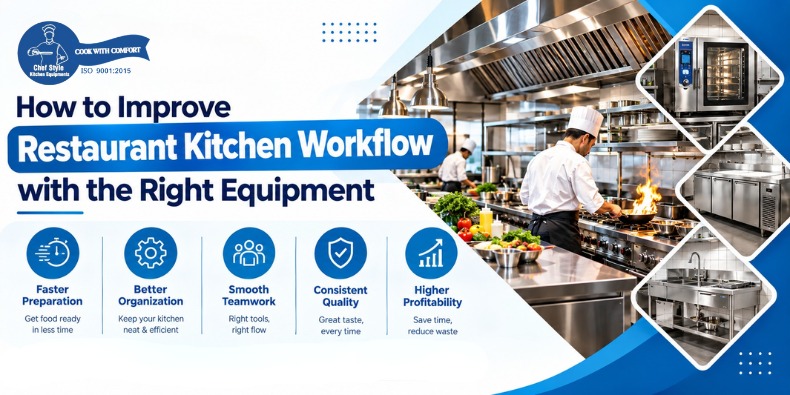
A busy restaurant kitchen needs more than skilled chefs and a good menu. The way equipment is selected, arranged, and used can have a major impact on kitchen speed, food quality, staff movement, and overall productivity. A well-planned restaurant kitchen workflow allows employees to move smoothly between preparation, cooking, plating, and cleaning without unnecessary delays.
Choosing the right commercial kitchen equipment and arranging it according to the kitchen’s workflow can help restaurants handle busy service periods more efficiently while making better use of available space.
Understand Your Kitchen Workflow First
Before purchasing new equipment, understand how food moves through your kitchen. Ingredients generally move from storage to preparation, then to cooking, plating, and finally service.
If staff members have to repeatedly cross the kitchen to collect ingredients or use equipment, it can slow down operations. Planning the kitchen around this movement can reduce unnecessary steps and create a more organised working environment.
This is why commercial kitchen design should focus not only on the appearance of the kitchen but also on functionality and workflow.
Choose Equipment Based on Your Menu
Every restaurant has different equipment requirements. A South Indian restaurant, bakery, fast-food outlet, café, and fine-dining restaurant will not need the same type of restaurant kitchen equipment.
Your menu should determine which cooking equipment, food preparation machines, refrigeration systems, and storage solutions you need. Selecting equipment based on actual kitchen requirements can prevent overcrowding and unnecessary investment.
For example, a high-volume restaurant may benefit from larger-capacity cooking and preparation equipment, while a smaller café may need compact and multifunctional equipment.
Arrange Equipment for Easy Movement
Equipment placement can directly affect kitchen productivity. Cooking equipment should be positioned so that chefs can easily access preparation areas, ingredients, utensils, and serving areas.
Refrigerators and preparation tables should be conveniently positioned, while equipment that is frequently used together should ideally be placed close to each other.
A practical arrangement helps reduce unnecessary walking and allows kitchen staff to complete tasks more quickly during peak hours.
Invest in Efficient Food Preparation Equipment
Food preparation can take up a significant amount of time in a commercial kitchen. Equipment such as commercial mixers, wet grinders, vegetable preparation machines, food processors, and dough kneaders can help reduce repetitive manual work.
The right commercial food preparation equipment can also improve consistency and help kitchen staff manage larger volumes of ingredients during busy periods.
However, equipment should be selected according to the restaurant’s actual production requirements rather than simply choosing the largest available machine.
Improve Cooking Efficiency
Cooking equipment is at the centre of most restaurant kitchens. Commercial cooking equipment such as cooking ranges, ovens, fryers, griddles, and specialised cooking systems should be selected based on the menu and expected order volume.
When cooking equipment has suitable capacity and is positioned correctly, chefs can move more efficiently between preparation and cooking. This can be particularly valuable during lunch and dinner rushes when order volumes increase significantly.
Use Refrigeration and Storage Strategically
Ingredients should be easy to access without creating unnecessary movement around the kitchen. Properly organised commercial refrigeration and storage can help staff locate ingredients quickly.
Commercial refrigerators, freezers, storage racks, shelves, and stainless steel workstations should be planned according to the kitchen layout and daily workflow.
Good storage organisation can also help reduce ingredient wastage and keep preparation areas less cluttered.
Don’t Ignore Ventilation
A comfortable working environment is important for kitchen productivity. Cooking produces heat, smoke, steam, and grease, particularly in high-volume commercial kitchens.
A properly designed commercial kitchen exhaust system can help remove cooking fumes and excess heat. Exhaust hoods, filters, ducting, and ventilation systems should be planned along with the cooking equipment rather than treated as a separate requirement.
Select Equipment That Is Easy to Clean
Cleaning is a continuous part of restaurant operations. Equipment with complicated designs or difficult-to-reach areas can take more time to clean and maintain.
Commercial kitchen equipment with smooth, easy-to-clean surfaces can help kitchen staff maintain better hygiene while reducing cleaning time. Stainless steel equipment is widely used in professional kitchens because it is durable, practical, and relatively easy to maintain.
Consider Equipment Capacity and Future Growth
Choosing equipment that matches your current workload is important, but future business growth should also be considered. If customer volume increases, equipment with insufficient capacity may become a bottleneck in the kitchen.
When planning a commercial kitchen setup, consider how your equipment requirements may change as the restaurant grows. A flexible kitchen layout can make it easier to add or upgrade equipment later.
Work With an Experienced Commercial Kitchen Equipment Supplier
Improving kitchen workflow is not simply about buying more equipment. The equipment needs to work together as part of an efficient kitchen system.
An experienced commercial kitchen equipment supplier in India can help restaurants evaluate their menu, available space, workflow, equipment capacity, and operational requirements before finalising the kitchen setup.
Professional guidance can also help with commercial kitchen design, stainless steel fabrication, equipment installation, and exhaust and ventilation planning.
Final Thoughts
An efficient restaurant kitchen depends on the right combination of layout, equipment, staff movement, storage, and workflow. Simply purchasing high-end equipment does not automatically create an efficient kitchen. Each piece of equipment should have a clear purpose and be positioned according to how the kitchen operates.
From commercial cooking equipment and food preparation machines to refrigeration, stainless steel workstations, storage systems, and exhaust solutions, every component should contribute to a smooth workflow.
For restaurants planning a new kitchen or upgrading an existing one, Chefstyle Kitchen Equipment can provide practical commercial kitchen solutions based on the restaurant’s menu, space, production requirements, and future growth.
A well-planned kitchen can help staff work more efficiently, reduce unnecessary movement, and create a smoother experience from food preparation to final service.