
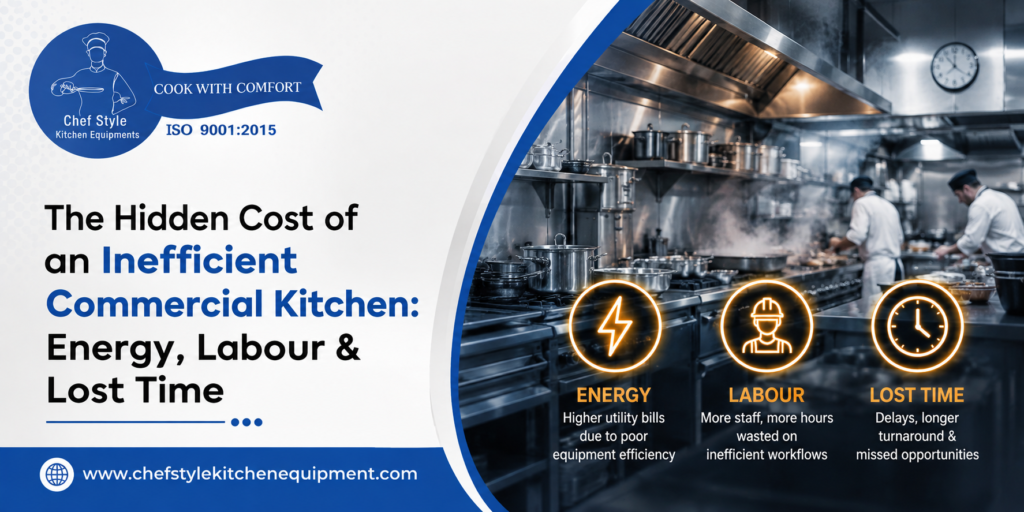
A commercial kitchen can be busy all day and still be inefficient.
The staff may be working continuously. Orders may be moving out. Equipment may be running from morning until closing.
Yet, at the end of the month, the operating costs can still be higher than expected.
Why?
Because inefficiency in a kitchen does not always come from one big problem. It often comes from small issues that happen repeatedly — unnecessary movement, poorly positioned equipment, wasted energy, slow preparation and time lost between tasks.
Individually, these problems may seem minor.
Together, they can become expensive.
Where Does the Extra Cost Come From?
Think about a typical busy restaurant.
A chef walks across the kitchen several times to collect ingredients. Another employee waits for access to a workstation. A refrigerator is opened repeatedly because ingredients are not organised properly. Cooking equipment remains switched on even when it is not being used.
None of these situations may appear serious.
But they happen every day.
When the same small inefficiencies are repeated across hundreds of working hours, they begin to affect the overall cost of running the business.
That is why improving kitchen efficiency is not simply about making the kitchen look organised. It is about reducing wasted time, energy and effort.
Energy Waste Can Stay Hidden
Energy is one of the major operating expenses in many food-service businesses.
Cooking equipment, refrigeration, ventilation and other systems may operate for long hours every day.
The problem is that energy waste is not always obvious.
Equipment may be running longer than necessary. Appliances may be poorly positioned around heat-producing equipment. Refrigeration units may be opened more often than required. An inefficient cooking process may also increase preparation time and energy consumption.
Over a single day, the difference may be difficult to notice.
Over a year, it can become a significant expense.
A well-planned energy efficient kitchen considers not only which equipment is purchased, but also how that equipment is used and positioned.
Labour Costs Are More Than Salaries
Labour is another area where inefficient planning can quietly increase costs.
If employees have to spend extra time walking, waiting or repeating unnecessary tasks, the business is paying for time that does not directly contribute to production.
Imagine a kitchen where a chef spends several additional minutes on unnecessary movement during every service.
That may not sound like much.
But repeat it across every shift, every week and every month, and the lost hours start adding up.
Better planning can help employees spend more of their working time on preparation, cooking, plating and service instead of moving around an inefficient workspace.
Time Is a Business Cost Too
In a restaurant, time has a direct connection with customer experience.
When preparation takes longer, orders can take longer.
When orders take longer, customers may have to wait.
During busy periods, even a small delay can affect several orders at once.
This is why an efficient kitchen needs to support a smooth sequence of work — from receiving ingredients to storage, preparation, cooking and service.
The objective is not simply to make people move faster.
It is to remove the unnecessary steps that slow them down.
More Equipment Does Not Always Solve the Problem
When a kitchen struggles to keep up with demand, the natural reaction may be to buy more equipment.
But adding another appliance does not automatically solve an inefficient operation.
If the existing space is already crowded, another piece of equipment may make movement even more difficult.
The real question should be:
What is slowing the kitchen down, and why?
Once the problem is understood, the right Commercial kitchen equipment can be selected and positioned to support the workflow instead of creating another obstacle.
Layout and Equipment Need to Work Together
A kitchen should be planned around the way food actually moves through the operation.
Storage should connect logically with preparation.
Preparation should lead naturally towards cooking.
Cooking should support plating and service.
Cleaning and waste handling should also be considered without interfering with the main workflow.
When equipment is placed according to this sequence, staff can work with fewer unnecessary movements.
This can make a noticeable difference during peak service, when every minute matters.
The Hidden Cost of Poor Planning
The biggest problem with an inefficient kitchen is that the costs are spread across different areas.
Energy bills may be slightly higher.
Labour hours may be slightly longer.
Food preparation may take slightly more time.
Equipment may be used less effectively.
None of these costs necessarily points to one obvious problem.
But together, they can reduce the profitability of the operation.
That is why business owners should look at the kitchen as a complete working system rather than judging individual problems separately.
Small Improvements Can Make a Difference
Improving efficiency does not always mean completely rebuilding a kitchen.
Sometimes, the first step is simply understanding what happens during a normal working day.
Watch where employees spend most of their time.
Identify equipment that is used constantly.
Look for unnecessary movement.
Check whether frequently used ingredients are easy to access.
Review which appliances consume the most energy and how often they actually need to operate.
These observations can help identify practical improvements before major investments are made.
Build the Kitchen Around the Business
Every business has different requirements.
A small café, a busy restaurant, a hotel kitchen and a large institutional kitchen may all need completely different setups.
The number of meals prepared, menu type, available space, staffing levels and service pattern all influence what the kitchen needs.
A good kitchen therefore starts with the business — not simply with a list of equipment.
When the design, equipment and workflow are planned together, the kitchen can become easier to operate and more prepared for busy service periods.
Efficiency Is About More Than Saving Money
Reducing energy and labour costs is important, but an efficient kitchen can offer other benefits too.
Staff can work more comfortably.
Tasks can become easier to manage.
Cleaning can be more organised.
Equipment can be used more effectively.
And customers can receive their orders with fewer delays.
In other words, efficiency improves the way the entire operation functions.
Conclusion
An inefficient commercial kitchen rarely has one obvious problem.
The real cost often comes from dozens of small inefficiencies repeated every day — extra movement, wasted energy, poorly positioned equipment and lost working time.
Over time, those small losses can have a real impact on the business.
The answer is not always to buy more equipment or hire more people. Sometimes, it starts with understanding how the kitchen works and planning the space and equipment around that workflow.
At Chef Style Kitchen Equipment, we focus on creating practical kitchen solutions that support the way commercial food businesses actually operate.
Because a well-planned kitchen does more than prepare food. It helps the entire business work more efficiently.