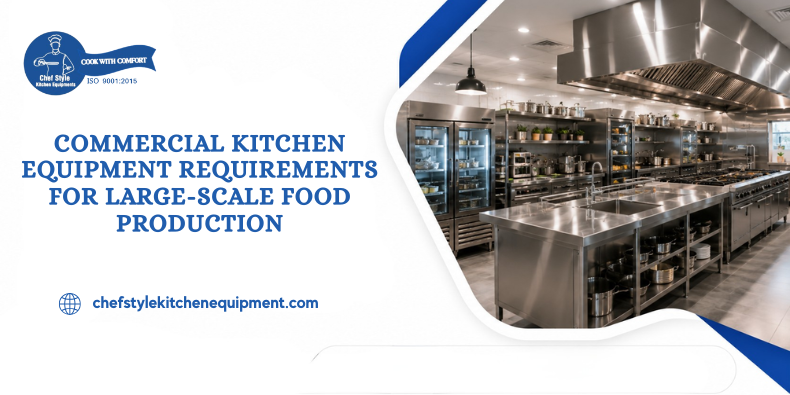
Large-scale food production requires a kitchen that can handle high volumes of ingredients and prepared food every day. Central kitchens, catering businesses, hotels, food factories, restaurants, and institutional kitchens may need to prepare hundreds or even thousands of meals within a fixed time.
In this type of operation, ordinary kitchen appliances are not enough. The kitchen needs strong equipment, proper storage, efficient cooking systems, good ventilation, and a practical workflow. Choosing the right Large Scale Kitchen Equipment can help businesses improve production speed while maintaining consistent food quality.
Understanding Large-Scale Kitchen Requirements
The equipment required for a large production kitchen depends on the menu, daily production capacity, available space, number of employees, and type of food being prepared.
A kitchen producing rice, curries, fried foods, bakery products, and snacks will have different requirements from a facility focused only on ready-to-eat meals.
Before purchasing equipment, it is important to understand the complete production process. Ingredients should move smoothly from receiving and storage to preparation, cooking, holding, packing, and dispatch.
A clear production flow can reduce unnecessary movement and help employees complete their work more efficiently.
High-Capacity Cooking Equipment
Cooking is usually the largest part of large-scale food production. When hundreds of portions need to be prepared, cooking equipment must be capable of handling large quantities without affecting food quality.
Commercial cooking ranges, large boiling systems, steam cooking equipment, deep fryers, ovens, tilting pans, grills, and rice cooking systems can support high-volume production.
The capacity of each appliance should be selected according to the expected daily output. Choosing equipment that is too small can increase cooking time, while unnecessarily large equipment may occupy valuable space.
Food Preparation Equipment
Large-scale production can involve considerable preparation work. Vegetables may need to be washed, peeled, sliced, chopped, or processed before cooking. Meat and other ingredients may also require preparation.
Commercial vegetable cutters, food processors, mixers, grinders, slicers, and dough kneaders can reduce manual work and improve production speed.
For businesses preparing the same ingredients every day, suitable Commercial Food Processing Equipment can also provide more consistent results.
Steam Cooking Equipment
Steam cooking is useful for many large-scale food operations. Rice, vegetables, idli, dumplings, and other products can be prepared using commercial steam cooking systems.
Steam-based cooking can help kitchens prepare larger quantities while maintaining consistent cooking conditions.
For food businesses that regularly prepare steamed products, selecting equipment with suitable capacity can make production more efficient.
Refrigeration and Cold Storage
Large-scale food production requires proper storage for both raw ingredients and prepared products.
Vegetables, meat, seafood, dairy products, sauces, and other perishable ingredients may need controlled-temperature storage.
Commercial refrigerators, deep freezers, and cold rooms can help businesses store ingredients safely and organize their inventory.
Storage capacity should be planned according to daily production and purchasing schedules. Good organization can also reduce food waste and make ingredients easier for staff to access.
Dry Storage and Ingredient Management
Dry ingredients such as rice, flour, pulses, spices, sugar, and other raw materials also require suitable storage.
Strong stainless steel racks and storage systems can keep ingredients organized and accessible.
A well-planned storage area should allow staff to check stock easily and follow a proper rotation system. This becomes especially important when the kitchen handles large quantities of ingredients every day.
Stainless Steel Workstations
Large production kitchens require strong preparation surfaces that can withstand continuous use.
Stainless steel work tables, preparation counters, sinks, shelves, and storage cabinets are commonly used in professional kitchens because they are durable, hygienic, and relatively easy to clean.
Using quality Stainless Steel Commercial Kitchen Equipment can help create a clean and practical working environment while supporting long-term kitchen operations.
Food Holding and Temperature Control
Food may not always be served immediately after cooking. In large-scale production, prepared food may need to be held temporarily before packing, transportation, or service.
Food warmers, bain maries, heated cabinets, and insulated food containers can help maintain suitable temperatures.
Proper food holding equipment can help protect food quality during busy production periods and reduce the pressure on kitchen staff.
Commercial Kitchen Exhaust Systems
Large-scale cooking generates significant amounts of heat, smoke, steam, and grease. Proper ventilation is therefore an essential part of the kitchen design.
Commercial exhaust hoods, grease filters, ducting, and ventilation systems can help remove cooking fumes and improve the working environment.
The exhaust system should be planned according to the type and capacity of cooking equipment used in the facility.
Washing and Cleaning Equipment
A large production kitchen can use hundreds of utensils, trays, containers, and cooking vessels every day.
The washing area should therefore have enough capacity to handle continuous cleaning. Commercial sinks, dishwashing systems, drainage facilities, and cleaning stations can help maintain a more organized operation.
Equipment should also be positioned so that dirty utensils and clean kitchenware follow separate paths wherever possible.
Packing and Dispatch Area
After food preparation and cooking, products may need to be portioned, packed, labelled, and transported to another location.
A dedicated packing area helps keep finished food separate from raw ingredients and preparation activities.
The dispatch area should also be located conveniently so packed food can leave the kitchen without disturbing the main production workflow.
This is particularly useful for central kitchens supplying multiple restaurants, catering events, or food outlets.
Energy Efficiency
Large-scale kitchens can consume significant amounts of electricity, gas, and water. Cooking equipment, refrigeration, ventilation, and cleaning systems may operate for many hours each day.
Energy-efficient equipment can help reduce operating costs over time.
When selecting equipment, businesses should consider not only the initial purchase price but also energy consumption, maintenance requirements, durability, and expected working life.
Equipment Layout and Workflow
Even high-quality equipment will not improve productivity if the kitchen layout is poorly planned.
Equipment should be arranged according to the production process. Storage should be accessible from the preparation area, while cooking equipment should be positioned close to preparation stations.
After cooking, food should have a clear route toward holding, packing, or dispatch.
A practical workflow can be:
Receiving → Storage → Preparation → Cooking → Holding → Packing → Dispatch
This reduces unnecessary movement and helps employees work more efficiently.
Hygiene and Safety
Large-scale kitchens handle large quantities of food and require strong hygiene practices.
Work surfaces should be easy to clean, storage should be properly organized, and raw and cooked food should be handled carefully.
The kitchen should also provide enough space around hot cooking equipment and allow staff to move safely between different workstations.
Proper ventilation, drainage, cleaning facilities, and equipment maintenance all contribute to a safer kitchen environment.
Plan for Future Production
A food business may increase production as customer demand grows. Therefore, equipment should not always be selected based only on current requirements.
If the business expects to add new products, increase order volume, or supply additional outlets, the kitchen should have enough flexibility for future equipment.
Planning for growth from the beginning can help avoid major modifications later.
Choosing the Right Equipment Supplier
The quality of the equipment is important, but supplier support is also worth considering.
Businesses should look at product quality, customization options, installation support, warranty, spare parts, and after-sales service before making a purchase.
A reliable supplier can also help businesses select equipment according to their kitchen layout, production capacity, and cooking requirements.
Conclusion
Large-scale food production requires more than simply installing powerful cooking appliances. Every part of the kitchen, from storage and preparation to cooking, ventilation, food holding, cleaning, packing, and dispatch, should work together.
Selecting suitable Large Scale Kitchen Equipment, reliable Commercial Food Processing Equipment, and durable Stainless Steel Commercial Kitchen Equipment can help food businesses improve productivity and maintain consistent food quality.
With proper planning and the right equipment, a large production kitchen can handle higher volumes, reduce unnecessary manual work, improve staff efficiency, and support the long-term growth of the food business.